Thermohaline Payments
30 Jul 2025
(**Thermohaline circulation shifts** → changes in deep currents driven by temperature (thermo) and salinity (haline))
tl:dr
- Explicit: There’s a lot going on in the unseen layers of Payments
- Implicit: It’s changing and so will competition
- Tacit: Learn how to navigate or at least understand what’s moving beneath
Intro and Warning:
I’ve been doing more work on AI and Product. Post that, and including a few discussions, I’ve seen some Payments companies and banks I’ve work/ed with using Gen AI for fraud detection, routing optimisation, and compliance.
I’ve also been thinking more about the end of inertia as a business model in Financial Services (mentioned in the AI x Product piece) – think loyalty points, non/low-interest bearing deposits etc. - so it seemed it might be time to deep-dive (sic.) further into the sea of payments.
1. Payments are driven by the invisible currents in the sea
Okay, the iceberg metaphor needs to degrade a bit (due to AI induced warming perhaps?) but it still holds insofar as the difference between the surface (ie what the customer sees) and the submerged infrastructure. However, We’re no longer talking just about heavy “infrastructure” - the physical rails and high volume hard tech processes often laid down decades ago. There is increasingly another layer at work here: software making decisions about how payments are processed, where they’re routed, whether they’re fraudulent and, potentially, which means of payment is used in the first place.
Some of this isn’t particularly new. Payment routing and fraud detection have been getting cleverer for years. But if AI starts taking a more active role in these decisions, rather than simply helping people make them, the implications could be rather more interesting.
Here’s a few items from the ever gushing stream of payments news:
-
Samsung Wallet BNPL: Buy Now, Pay Later incorporated into an in-store wallet experience. Nothing particularly revolutionary from the customer’s perspective, but there’s credit decisioning and risk management behind what appears to be another payment option (via Android Central).
-
X Money with Visa: Payments embedded into a social platform, with Visa providing some of the underlying capabilities. The interesting question is perhaps who actually owns the customer relationship. (via Reuters).
-
Wero rollout in Europe: A European payments initiative intended to reduce dependence on existing international payment arrangements. Quite a different motivation from the other two, and potentially more interesting from a competition perspective. (via BNP Paribas).
2. What’s going on down there?…
Thought about in this way, competition no longer lives only on the surface of apps (once were icebergs — if that’s not clear from the previous metaphor (-‸ლ) see NB below). It’s increasingly happening in the infrastructure and software behind them.
For example, two payments providers might offer almost identical customer experiences but have quite different economics depending on how successfully they detect fraud, route transactions or manage the associated costs.
None of that is particularly new. Banks and payment processors have been optimising these things for years. What’s changing, potentially, is how much of the decision-making can be handed over to software and how quickly it can respond.
Generative and agentic AI could extend this into reconciliation, risk monitoring and compliance, although I suspect there’s a fair distance between helping someone investigate a suspicious transaction and allowing an AI agent to decide what to do about it. (via ThoughtWorks). And then there’s the question of who controls all of this. The bank, the payment processor, the wallet provider or, increasingly, an agent acting on behalf of the customer?
So there’s some choreography needed. Quite possibly involving more participants than anyone originally invited.
3. The Economics of Navigation
To a large extent on the surface, payments are about speed and convenience and always have been.
But there’s a fair bit of economics beneath that.
The cost of a transaction depends, amongst other things, on which rail carries it, the parties involved and the arrangements between them. Fraud management, authorisation rates and liability all influence the economics, although most customers are probably not terribly interested in any of this as long as the payment works. And then there’s loyalty.
In the previous AI x Product piece I mentioned the potential end of inertia as a business model. Financial Services has traditionally benefited, at least in part, from customers not continuously optimising every financial decision they make. An AI agent selecting a payment method on behalf of a customer might start changing that. Although whether it optimises for the customer, the merchant, the wallet provider or whoever owns the agent is a rather important question.
Which brings us back to the economics.
If one provider can consistently route a payment more cheaply, manage the risk more effectively or select a better payment method, there’s value in that. But who gets to keep it? The merchant? The bank? The orchestrator? The customer? Or perhaps the platform that decides which of the others gets used? I suspect that’s where some of the more interesting competition will emerge.
It’s also where the distinction between AI as an accelerator and AI as an autonomous participant becomes important. Improving an existing process is one thing. Allowing software to make decisions that affect where economic value ends up is quite another.
Which leaves me wondering whether the next significant change in payments will be visible to customers at all. The original iceberg argument was that mobile banking had transformed the experience of making and managing payments without necessarily changing much of the underlying process. Perhaps what’s changing now is more significant, even if the customer continues to see little more than a confirmation that their payment has gone through.
The infrastructure remains largely invisible, but increasingly consequential decisions about how it’s used may be made elsewhere. And, rather inconveniently for the iceberg metaphor, what happens beneath the surface might be becoming more important than what happens above it.
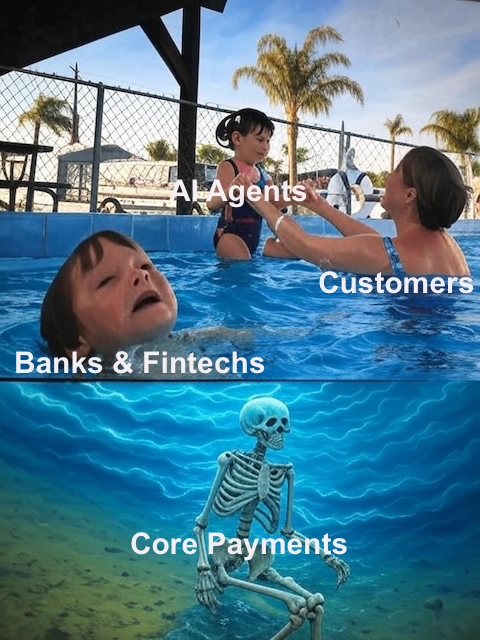
N.B. For reference, I’ve also decided to officially retire this metaphor (I should probably stop using them at all - a digital descriptive detox sounds good? At least there was only one cheesy meme…)