Product Generative pre-trained Transformers - Roll Out!
11 Nov 2024tl:dr
- Ai will change everything including Product but how?
- AI : What/Where?
- AI and Product
- Concluding thoughts
Intro and Warning:
The second item off the backlog (now so overloaded I should probably call it a hernialog). Having already re-organised my under-stair cupboard full of Product, I thought I should do the same with regards to AI and it’s quite long
(Epistemic status : I’ve done some courses and company training (my company works with multiple vendors including OpenAI - although I still tithe $20/month for a personal use of Skynet to feed it the products of my wetware). We recently built a GenAI agent to augment Business Analysts by producing requirements from any form of project documentation. We’ll probably harvest their meatsacks subsequently… )
So, similar to Mobile Payments AI is going to change everything and that includes Product.
1. AI-AI-AI-O Along the Gartner Hype we go
Why does any of this matter? Because in the way in which the ability to view online coffee machines, join bulletin boards, Gopher content and send exciting Hotmails to your few similarly over excited peers gave no-one any premonition of anti -Social Media, Amazon, Netflix, Spotify or Hackers controlling your fridge - the current view of AI as Google on Steroids or ‘write the boring parts/fill in the gaps’/help with some ideas, gives us no idea what it is going to change.
The change will almost certainly mirror the way in which early netizens foresaw shared knowledge, greater connectivity and unparalleled creativity only to end up via Pets.com and Google Glass, sitting alone doom-scrolling, ordering food, hurling abuse at strangers or browsing endlessly through catalogues of media, cheap imported goods or distractions.
Less floridly, in the words of Steve Jobs:
“You can’t connect the dots looking forwards, you can only connect them looking backwards”
2. AI: State of the Autonation
Not going to happen very often for reasons way outside of these thoughts — not least because I have become somewhat allergic to conversations which contain such a phrase — but to quote Michel Foucault:
“People know what they do; frequently they know why they do what they do; but what they don’t know is what what they do does. (Madness and Civilization: A History of Insanity in the Age of Reason)
To begin then, what?
(ABC of AI follows feel free to (skip))
AI refers to the development of computer systems and algorithms that can perform tasks typically requiring human intelligence.
It can be grouped by capability, functionality or technology:
1. Capability
The level at which it can function
- Narrow - single or limited range of tasks (often equal to or better than humans) - think voice assistant, image recognition or recommendation systems.
- General AI (AGI) - as yet hypothetical systems that can learn and apply intelligence to a range of tasks at, or above human level. Can reason, solve problems, make judgements, plan, learn and communicate in unfamiliar situations.
- SuperIntelligence - surpasses human intelligence across all relevant fields including creativity, general wisdom and problem solving.
2. Functionality
What it can do
- Reactive - can react to different situations but do not have memory-based functions i.e. cannot use past experience to inform future decisions. Perhaps surprisingly includes IBM’s Deep Blue chess program which famously beat World Chess Champion Gary Kasparov in 1996/97. (Surprising to those who don’t play chess a lot or consider that it can be ‘brute-forced’ ie each successive move can be the best move based on the sum of all best possible scored moves).
- Limited Memory - can use past experiences to inform future decisions - most current AI applications from Tesla autonomous driving to Siri/Alexa/Assistants fall under this category.
- Theory of Mind - (Uh Oh) future AI that could understand emotions, people and other AIs to then adjust its behaviour.
- Self-Aware AI (Skynet) - the most advanced future form of AI which could have it’s own consciousness, sentiments and self-awareness…
3. Technology
How the end result is achieved and thus a bit fuzzy/overlapping:
- Machine Learning - AI systems which improve their performance over time by learning from data without being programmed (often used in multiple ways in multiple applications):
- Supervised Learning (Think Speech recognition, fraud detection, spam filters)
- Unsupervised Learning (Some of the above also use this but think also of recommendation systems, image compression, genetic data analysis)
- Reinforcement Learning (Again used in some of the above but also think of traffic light control, industrial automation/robotics, game playing)
- Deep Learning - a subset of Machine Learning based on artificial neural networks (recognising patterns and making decisions by mimicking how the human brain processes information through connected layers of simple calculations) - used in many of the previous applications
- Natural Language Processing - enables machines to understand, interpret and respond to human language. (Try to think of more than chatbots which are generally atrocious…)
- Robotics - AI that is embodied in physical units which can perform tasks or movement. (Can use subsets of the above)
- Computer vision - AI that can interpret the visual world using cameras, videos etc. (Uses different subsets of the learning models)
From all this we can see that a particular usage eg Chat GPT fits into several categories within any taxonomy - Narrow, Limited Memory (outside of a session), uses Machine Learning and Natural Language Processing. For a much more in-depth understanding of GPT - what is going on and why there’s no better source than Gwern.
About this singularity then…?
(For anyone blessedly unburdened by this idea — a bunch of luminaries have suggested there comes a point at which technological growth becomes uncontrollable and irreversible resulting in unforeseeable consequences for human civilisation, including IJ Good, John von Neumann, Alan Turing, Stanislaw Ulam, Vernor Vinge and Ray Kurzweil)
That’s leaving aside the scores of AI researchers who are worried about the ‘alignment problem’ whereby any AI systems objectives match those of it’s designers/users and match widely shared values, ethical standards or the intentions of the designers.
This ranges from live issues in the discriminatory present: eg estimating if a criminal is likely to re-offend, hiring, offering loans, facial recognition —
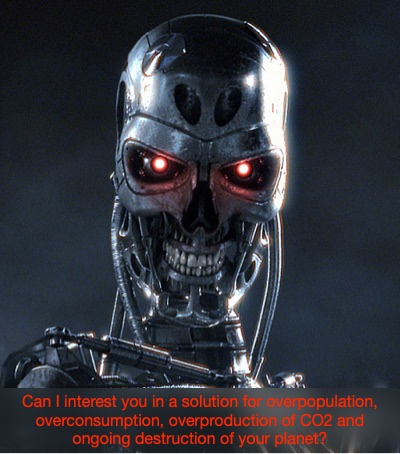
— to the potentially existential future (given prospective developments) eg letting a machine solve the biggest self-inflicted problems of our time…
But, before we start building a time-machine to go back and convince various people in San Francisco to pursue alternative careers, where are we and how is it going?
A definite tangent line to the curve but for a personal perspective on AI I try to understand it from simple first principles. At this stage (ie Pre AGI and pre Super Intelligence) it is first and foremost a tool. That’s ignoring the issues (for now) of whether the tool can understand what I want to do, understand the problem, understand how to help me either make a decision or execute the solution for me. We can make the tool super efficient and more useful in lots of specific ways but these may deviate from it’s overall utility.
In the digital world, Excel (now arguably Turing Complete) can be also be used for: Programming, Art, Photos and Animations, Games as well of course to terrify/suck the life out of any meeting. That’s just an example of people trying to see if you can push the uses of a tool outside of it’s main purpose.
However, there was an ongoing adage that went along the lines of:
“Why are the shafts of screwdrivers still made to be so thick and strong? Because otherwise people wouldn’t be able to open tins of paint with them!”.
Aside from pointing out that it’s necessary to really understand what customers want from/use your product for, it hints at the limitations of maximising single dimensions of performance. I haven’t tried it but wouldn’t be keen to attempt opening a tin of paint with the flat-head bit in my cordless screwdriver just yet.
That’s not an argument against the usefulness of either but there are plenty of challenges to the inevitable replacement of one set of useful things by others.
Before moving on to think about Product, there are plenty of these heterodox views on AI.
Here’s one fron NPR : 10 Reasons why AI may be overrated and here’s one from the Economist What happened to the artificial-intelligence revolution (Paywalled but let me know if you want to read it). There’s lots of others but here’s an AI summary of both articles:
-
Substantial Investments with Limited Creative Output: Despite major tech firms like Alphabet, Amazon, Apple, Meta, and Microsoft investing approximately $400 billion in AI, the technology primarily excels in pattern recognition and mimicking human outputs, lacking in genuine creativity and the ability to generate new ideas.
-
Current AI vs. AGI: Today’s AI, far from achieving Artificial General Intelligence, functions more as an “autocorrect on steroids” without true independent judgment or reasoning capabilities, evidenced by its narrow application in fields like customer service and marketing.
-
Practical and Ethical Limitations: AI’s reliability issues and fundamental limitations in understanding or generating ethical content make it unsuitable for replacing humans in most jobs that demand high quality, creativity, or ethical judgments, such as those beyond routine customer service tasks.
-
Overestimated Capabilities and Economic Impact: The effectiveness and transformative potential of AI have been overstated with AI-generated outputs not meeting high-quality standards, similar to a Roomba’s functionality in vacuuming; economically, there’s minimal evidence of AI-induced layoffs or significant productivity gains.
-
Investor Skepticism and Slow Adoption Trajectory: Despite high usage among knowledge workers and substantial investments, the broader business adoption of AI is slow, with investor skepticism reflected in AI-centric stock indexes not outperforming the market, indicating a gradual adoption curve similar to other technological innovations.
From current professional experience and discussions with colleagues I would add that there’s a danger Financial Institutions may repeat their usual patterns with AI - treating it as a trendy solution in search of an actual problem. They recognize AI as the next big thing and having secured large budgets and Empires, are massively compensating experts, who then feel compelled to validate their roles. Despite lessons available from agile methodologies, they could continue to approach AI development with outdated, waterfall-style project management. Furthermore, there’s little advantage to be gained since peers are adopting AI in similarly awkward manners, neutralizing any potential competitive edge.
3. I, for one, welcome our new robot Product Overlords
For some the revolution is underway: Product Management is Dead (or Will Be Soon) by Claire Vo (LaunchDarkly)
Despite the click-baity headline there’s some useful points in there. Summarised below:
(Unironically from an AI Youtube summarizer with a few points added by me since ironically it wasn’t that good…)
Warning: Blurb ahead (skip)
Key Points:
a. Product Management is Changing:
- Faster than expected
- AI is poised to transform roles in product design and engineering quickly.
- Traditional methods of creating product strategies are evolving to become more efficient with AI.
b. Efficiency Gains:
- Automate to speed up delivery
- Previous methods required weeks for strategy creation, now it can be achieved in a fraction of the time using AI tools like ChatGPT.
- Tasks like drafting documents, gathering feedback, and monitoring goals can be automated, allowing product teams to focus on more strategic innovation.
- Use AI to accelerate common tasks:
- Include writing updates, and creating agendas.
- Monitoring goals (OKRs), tracking competitors, and preparing for interviews.
- Creating customer stories, enhancing presentations, and explaining product functionality.
- Aim to achieve 75% progress quickly with AI assistance, rather than striving for 100% automation.
c. Skills Adaptation:
- Product managers should now learn new skills, such as design and prototyping, to remain relevant and effective.
- The future of product management entails becoming a generalist with capabilities across multiple disciplines.
d. Team Dynamics:
- Roles are evolving
- The traditional “product triad” model may dissolve, leading to a more integrated role where individuals possess multiple skills across product management, design, and engineering.
- Explore more topologies
- The culture of “no lanes” is encouraged, where team members tackle various tasks irrespective of their designated roles.
- Teams will need to adapt to this shift without being intimidated by the collapse of traditional job boundaries.
e. Preparing for Future Challenges:
- Product leaders need to adapt to managing diverse teams with shared skills and work toward building AI-powered teams rather than relying solely on traditional structures.
- Fewer PM’s will be needed - - AI will consolidate previously distinct roles, leading to a new model where one person, with the aid of AI, can manage design, engineering, and product functions—creating an “AI-powered triple threat.”
- Emphasizing commercial and technical skills will be crucial for product managers’ roles in the future.
- Start Adapting Now - AI-driven changes will happen fast. Begin integrating AI into team processes and management strategies immediately.
4. Is it really, though?

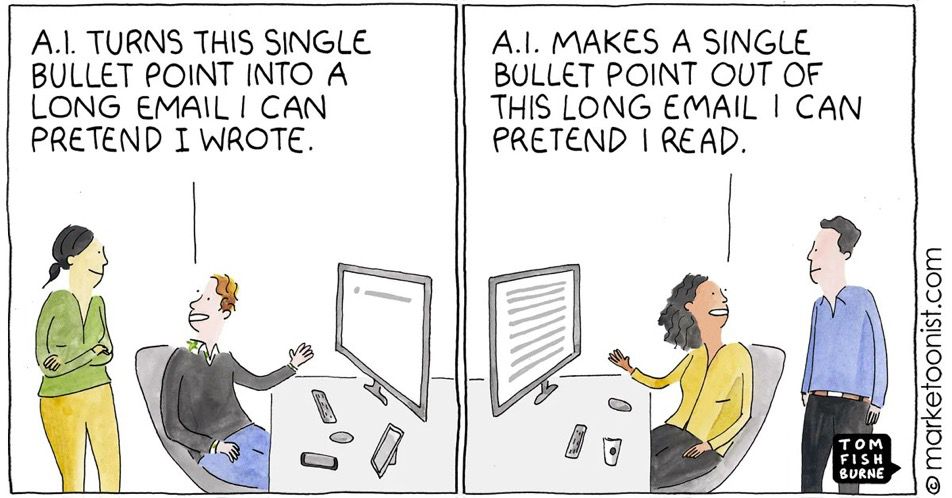
(And yes - cartoonized this meme with one AI and then used another AI to remove the watermark from the first AI…)
There are obvious potential and current uses beyond summarizing documents/interviews for requirements and generating designs.
-
AI can drastically improve product discovery by analyzing customer data and market trends to identify unmet needs and new opportunities, enabling data-driven decisions about what products and features to develop.
-
AI tools could assist in defining product features and priorities by using predictive analytics to forecast market acceptance and potential profitability.
-
AI can facilitate design beyond enhanced design tools exploring multiple possibilities via rapid prototyping and testing - simulating user interactions and providing real-time feedback, allowing for iterative design improvements based on user behavior and preferences.
-
AI can optimize the delivery process in a multitude of ways already, speeding up the go-to-market timeline and reducing human error. Post-launch, AI can continue to influence product management by analyzing user feedback and usage patterns to recommend enhancements, detect issues, and predict future trends, ensuring the product evolves in line with user needs and market dynamics.
A couple of the above points raise some genuinely transformational thoughts:
- Product as Platform : Instead of focusing on specific products and their development lifecycle, with AI, products could become platforms that constantly evolve based on AI-driven data insights and user interactions. This shift requires overseeing an ecosystem where the product adapts and morphs over time without explicit human direction after initial parameters are set. Product lifecyle changes compoletely with “self-evolving products”, Products could iteratively improve at a pace that outstrips traditional development cycles, leading to faster introductions of new features and quicker responses to market changes.
- New dimensions in market dynamics and competitive strategy: Existing theories rely on relatively stable product offerings and well-defined market segments. Markets may become more fluid, with AI-driven products continuously redefining their own market niches. Product managers would then need to understand not only their product and customers but also the underlying AI technologies that drive continuous adaptation.
- Navigating the “Idea Maze”: AI assists in exploring multiple design possibilities through what is described as an “idea maze”, which involves navigating through various decision paths, thereby potentially increasing the chances of achieving successful outcomes.
To build on the last thought (borrowing heavily from discussions with “il miglior fabbro” at intuitably) and return to the first principles (ie Does AI understand the problem or does the Product Manager, and if so does AI make or inform a decision?) it is worth remembering that arguably one of the key parts of Product management (Product/Market fit) is not a binary.
It is instead trying to move your product through the ‘space’ of all potential products to optimise the vector quantity of ‘fitness’. The Product Manager’s role is to infer the topology of this product-space based on available data so that design/build people can move the product in the right direction. Data about this space is often poor - undersampled, contradictory and phrased in deceptive language (“What did you want to use that screwdriver for again?”) A lot of inference/context/creativity is also required to construct an accurate map. Building and using AI in this way could be… interesting.
Somewhere between the butter robot and the words from one of the best films of all time that’s why we can’t open the product bay doors just yet… I think you know what the problem is just as well as I do… This mission is too important for me to allow you to jeopardize it.